

Another rant on splines
A spline isn't just any piece of wood spanning a joint.

I’m starting to think that people don’t actually like miters.
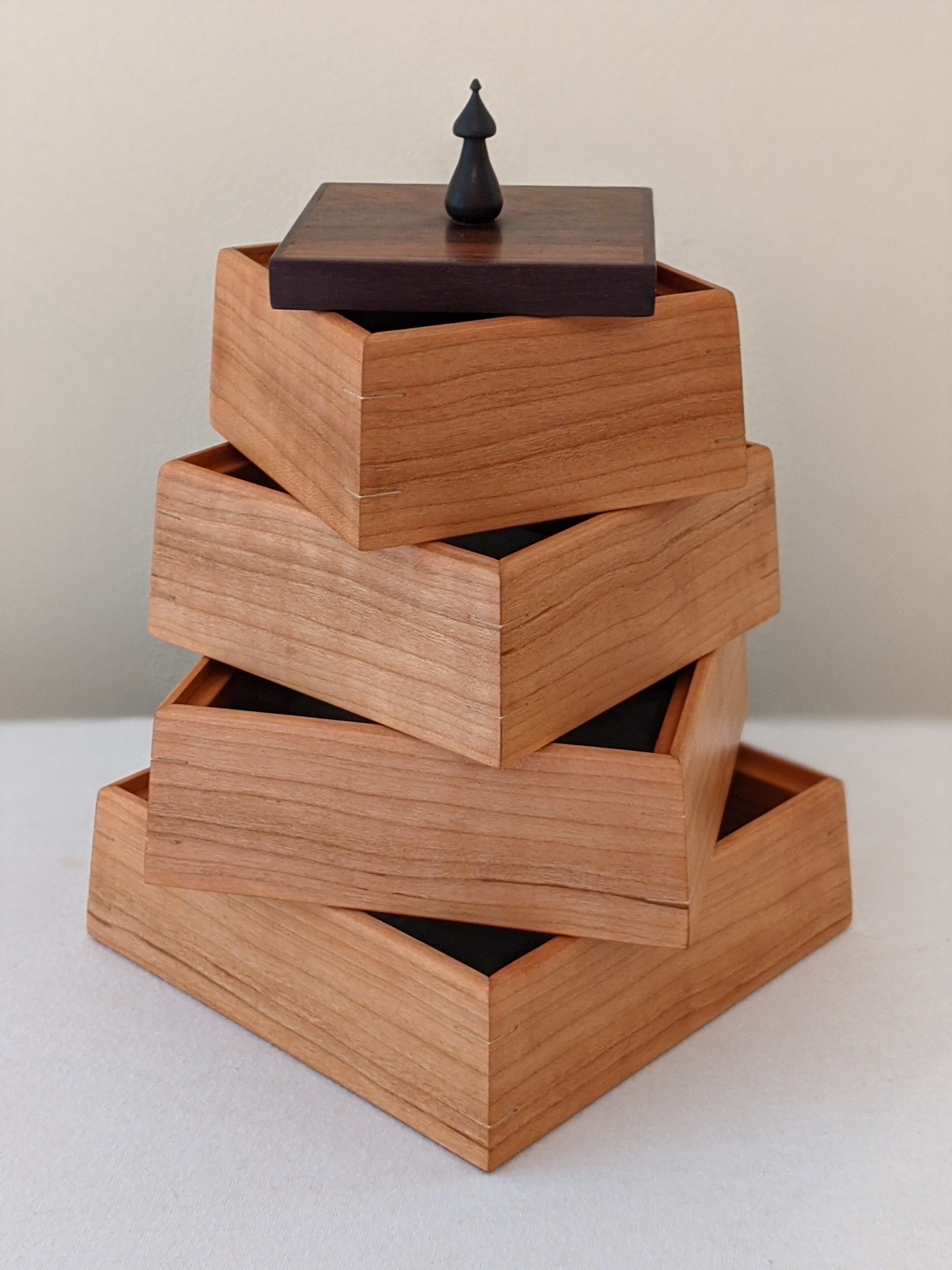
I mused on this a bit in an earlier rant. My argument is effectively that when one chooses to use a miter in a project, they have already decided (or should have) that aesthetic needs outweigh structural ones. This isn’t a value judgment - the miter is an attractive looking joint that is perfectly fine in plenty of situations, but it is most certainly not a very strong.
The problem with the miter, then, isn’t so much the joint itself. It’s the stuff that folks do to it afterward, usually in the name of providing additional reinforcement. Somehow, it’s been drilled into people that miters must be reinforced, and because of that, they can produce some pretty interesting solutions. A better approach is to focus on when a miter is a good choice or not to begin with.
Without a doubt the most interesting reinforcement solution l’ve seen came via a reader question. They were working on some miters and were looking to reinforce them. After searching for a while, they got to wondering why they could only find one article on the internet suggesting what you see in the picture below.
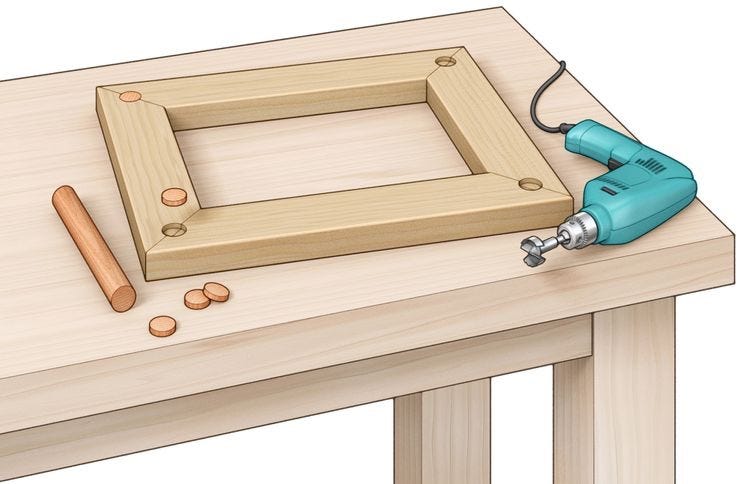
That picture is from a very brief Wood Magazine post titled “Dowel Disk Reinforcement.” From the post:
One day l had a brainstorm to use disk cuts from dowel rods as reinforcement for wood joints. It functions like a spline except it’s located on the surface of the joint.
I’m not so sure it functions like a spline. The entire purpose of a spline is to provide long grain to long grain wood contact for a strong glue joint. When you make a “disc cut” from a dowel, the two large faces of the resulting piece are entirely end grain. Gluing a thin disc of end grain on top of a miter joint just doesn’t do the same thing a true spline does.
I do realize there is a bit of long grain contact here, but it’s all via the sidewalls of the dowel disc. That ain’t all that much, and half of it is going to touch end grain in the mortise it eventually occupies anyway.
I’m not going to say that this doesn’t provide any reinforcement for the joint. I’ve learned to never speak in absolutes when it comes to wood, and there could indeed be scenarios I’m not considering. I’m also not going to argue over the aesthetics of it if that’s what you like. But I’m highly suspect that this method produces any meaningful advantage, and throwing it out there without a detailed explanation of exactly what is going on and why it works is probably going to confuse beginners.
I don’t mean to pick on anyone for a three-year-old magazine article. I just think this is a good example of how sometimes “truths” in woodworking (”miters MUST have splines”) can lead you to missing the forest for the trees. Another example I’ve seen of this is a someone go on and on about how they were using splines to reinforce their joints, only for the ones they used to be entirely short grain.
Rules of thumb are great, but if the meaning behind the rule is misunderstood, you end up with some goofy stuff.
On small boxes a miter by itself is fine, never had one fail unless you throw it at the wall. For a larger picture frame I’ll use a biscuit, hidden and amazingly strong. For a waterfall slab that is thick and heavy then I’m all in for multiple dominos or floating tenons.